Monday, 15th June 2026
Breaking News :
Potential Removal of Awami League Political Prohibition Graft-Accused Ex-Advisers Tipped to Leave Bangladesh Hasnat and Sadik Face Oxford Deception Allegations Israel Declares Alert Over Impending Iranian Attack Diplomatic Meeting Enacts Key Neutral Peace Framework Two Brothers Killed In Fatal Motorcycle Accident Pallabi Child Rape and Homicide Suspects in Court Raw Hide Market Defies Official Price Guidelines Nationwide US Sanctions Remain Despite Iran Uranium Handover Washington Launches Defensive Strikes On Southern Iranian Port Potential Removal of Awami League Political Prohibition Graft-Accused Ex-Advisers Tipped to Leave Bangladesh Hasnat and Sadik Face Oxford Deception Allegations Israel Declares Alert Over Impending Iranian Attack Diplomatic Meeting Enacts Key Neutral Peace Framework Two Brothers Killed In Fatal Motorcycle Accident Pallabi Child Rape and Homicide Suspects in Court Raw Hide Market Defies Official Price Guidelines Nationwide US Sanctions Remain Despite Iran Uranium Handover Washington Launches Defensive Strikes On Southern Iranian Port Potential Removal of Awami League Political Prohibition Graft-Accused Ex-Advisers Tipped to Leave Bangladesh Hasnat and Sadik Face Oxford Deception Allegations Israel Declares Alert Over Impending Iranian Attack Diplomatic Meeting Enacts Key Neutral Peace Framework Two Brothers Killed In Fatal Motorcycle Accident Pallabi Child Rape and Homicide Suspects in Court Raw Hide Market Defies Official Price Guidelines Nationwide US Sanctions Remain Despite Iran Uranium Handover Washington Launches Defensive Strikes On Southern Iranian Port Potential Removal of Awami League Political Prohibition Graft-Accused Ex-Advisers Tipped to Leave Bangladesh Hasnat and Sadik Face Oxford Deception Allegations Israel Declares Alert Over Impending Iranian Attack Diplomatic Meeting Enacts Key Neutral Peace Framework Two Brothers Killed In Fatal Motorcycle Accident Pallabi Child Rape and Homicide Suspects in Court Raw Hide Market Defies Official Price Guidelines Nationwide US Sanctions Remain Despite Iran Uranium Handover Washington Launches Defensive Strikes On Southern Iranian Port Potential Removal of Awami League Political Prohibition Graft-Accused Ex-Advisers Tipped to Leave Bangladesh Hasnat and Sadik Face Oxford Deception Allegations Israel Declares Alert Over Impending Iranian Attack Diplomatic Meeting Enacts Key Neutral Peace Framework Two Brothers Killed In Fatal Motorcycle Accident Pallabi Child Rape and Homicide Suspects in Court Raw Hide Market Defies Official Price Guidelines Nationwide US Sanctions Remain Despite Iran Uranium Handover Washington Launches Defensive Strikes On Southern Iranian Port Potential Removal of Awami League Political Prohibition Graft-Accused Ex-Advisers Tipped to Leave Bangladesh Hasnat and Sadik Face Oxford Deception Allegations Israel Declares Alert Over Impending Iranian Attack Diplomatic Meeting Enacts Key Neutral Peace Framework Two Brothers Killed In Fatal Motorcycle Accident Pallabi Child Rape and Homicide Suspects in Court Raw Hide Market Defies Official Price Guidelines Nationwide US Sanctions Remain Despite Iran Uranium Handover Washington Launches Defensive Strikes On Southern Iranian Port Potential Removal of Awami League Political Prohibition Graft-Accused Ex-Advisers Tipped to Leave Bangladesh Hasnat and Sadik Face Oxford Deception Allegations Israel Declares Alert Over Impending Iranian Attack Diplomatic Meeting Enacts Key Neutral Peace Framework Two Brothers Killed In Fatal Motorcycle Accident Pallabi Child Rape and Homicide Suspects in Court Raw Hide Market Defies Official Price Guidelines Nationwide US Sanctions Remain Despite Iran Uranium Handover Washington Launches Defensive Strikes On Southern Iranian Port Potential Removal of Awami League Political Prohibition Graft-Accused Ex-Advisers Tipped to Leave Bangladesh Hasnat and Sadik Face Oxford Deception Allegations Israel Declares Alert Over Impending Iranian Attack Diplomatic Meeting Enacts Key Neutral Peace Framework Two Brothers Killed In Fatal Motorcycle Accident Pallabi Child Rape and Homicide Suspects in Court Raw Hide Market Defies Official Price Guidelines Nationwide US Sanctions Remain Despite Iran Uranium Handover Washington Launches Defensive Strikes On Southern Iranian Port Potential Removal of Awami League Political Prohibition Graft-Accused Ex-Advisers Tipped to Leave Bangladesh Hasnat and Sadik Face Oxford Deception Allegations Israel Declares Alert Over Impending Iranian Attack Diplomatic Meeting Enacts Key Neutral Peace Framework Two Brothers Killed In Fatal Motorcycle Accident Pallabi Child Rape and Homicide Suspects in Court Raw Hide Market Defies Official Price Guidelines Nationwide US Sanctions Remain Despite Iran Uranium Handover Washington Launches Defensive Strikes On Southern Iranian Port Potential Removal of Awami League Political Prohibition Graft-Accused Ex-Advisers Tipped to Leave Bangladesh Hasnat and Sadik Face Oxford Deception Allegations Israel Declares Alert Over Impending Iranian Attack Diplomatic Meeting Enacts Key Neutral Peace Framework Two Brothers Killed In Fatal Motorcycle Accident Pallabi Child Rape and Homicide Suspects in Court Raw Hide Market Defies Official Price Guidelines Nationwide US Sanctions Remain Despite Iran Uranium Handover Washington Launches Defensive Strikes On Southern Iranian Port

World

Fast Attack Craft Defiance Controls Strait Of Hormuz

Khabor Wala Desk

Published: 15th June 2026, 5:43 PM

Fast Attack Craft Defiance Controls Strait Of Hormuz

Iran’s Islamic Revolutionary Guard Corps (IRGC) Navy has utilized its decentralized fleet of fast attack craft, often characterized as a “mosquito fleet,” to counter United States naval forces and maintain control over the strategically vital Strait of Hormuz. This maritime confrontation intensified following a series of military engagements in the Middle East earlier in the year, which severely disrupted standard security protocols in the region’s shipping lanes.

Geopolitical Escalation and Maritime Blockade

The heightened state of conflict began on 28 February, when a joint US-Israeli operation launched strikes against Iranian targets while diplomatic talks regarding enriched uranium and ballistic missile issues were actively ongoing in Geneva. In retaliation, Iran executed a 39-day counter-offensive, launching 100 distinct retaliatory strikes targeting Israeli territories as well as various US military installations situated across the Middle East. While these precise strikes placed the joint coalition forces under severe operational strain, the primary focus of the conflict rapidly shifted toward the narrow shipping corridors of the Strait of Hormuz.

In an attempt to secure commercial oil tankers navigating through the region, the United States imposed a naval blockade on the strait on 13 April. However, Iran countered this deployment by mobilizing its extensive fleet of small, high-speed, offensive speedboats. The IRGC Navy possesses an inventory of more than 1,500 of these small combat vessels, each weighing less than 10 tonnes. Rather than relying on individual survivability, the operational doctrine of this fleet is centered around overwhelming opposing naval defences through coordinated, large-scale swarm attacks.

Technical Capabilities and Radar Evasion

These fast attack craft are engineered to operate at velocities ranging between 50 and 110 knots. Their extreme speed and agile maneuverability drastically compress the reaction time available to target ships during an engagement. Consequently, the highly sophisticated radar arrays and automated fire-control systems installed on the United States Navy’s guided-missile destroyers frequently struggle to effectively track and neutralize a synchronized, multi-directional swarm. Through the persistent deployment of these speedboats, the IRGC has maintained a rigid defensive posture and strict oversight across the Persian Gulf.

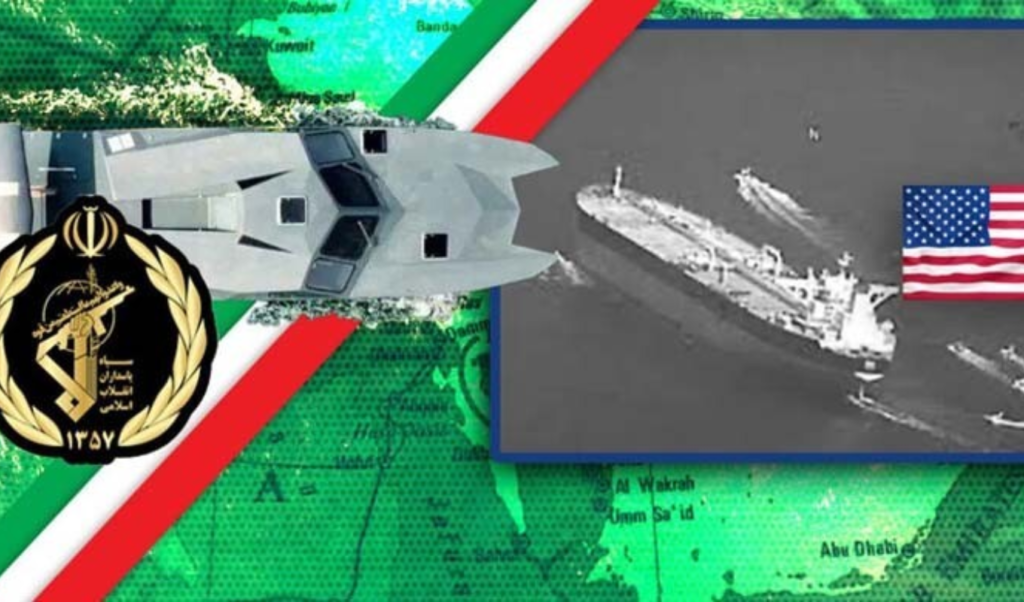
A significant technological component of this fleet is the Heydar-110, a specialized missile boat officially unveiled by the IRGC Navy on 27 February 2025. Boasting a maximum speed of 110 knots (approximately 203 kilometres per hour), the Heydar-110 is recognized as the fastest military watercraft currently in operation globally. The vessel measures roughly 14 metres in length, has an operational range of 350 nautical miles, and is configured to carry two anti-ship cruise missiles. Constructed with advanced radar-evading stealth technology, the craft features a heavily minimized radar cross-section, making detection highly problematic for conventional naval surveillance systems.

Fleet Classifications and Subterranean Operations

The broader Iranian high-speed maritime inventory, collectively designated as the “Red Wasp” fleet, comprises several distinct classes of specialized watercraft tailored for rapid engagement:

  • Ashura Class: Capable of achieving operating speeds up to 90 knots.

  • Seraj Class: Designed to maintain a operational speed of 65 knots.

  • Tareq Class: Capable of exceeding velocities of 90 knots during interception.

  • Tondar Class: Formatted specifically to transport and launch long-range anti-ship missiles.

  • Unmanned Surface Vessels (USVs): Remote-controlled drone boats designed to execute precise, long-distance explosive strikes.

Throughout the 40 days of direct maritime friction, the IRGC Navy deployed these varied assets to present a profound asymmetric challenge to US naval supremacy. A key tactical advantage for the Iranian forces is their ability to station these vessels within heavily fortified subterranean bases and coastal caves carved beneath coastal mountains. The fast attack craft can emerge rapidly from these hidden bunkers to launch surprise ambushes on transiting warships before retreating back into the safety of the terrain. This highly elusive operational cycle successfully prevented US forces from establishing absolute control over the Strait of Hormuz.

Military analysts have noted that the sheer volume of Iran’s small-craft inventory makes a complete neutralisation of the fleet logistically unfeasible for opposing forces. Although US naval helicopters managed to destroy a segment of the speedboats during the skirmishes, the decentralized command structure and vast reserves allowed Iran to seamlessly deploy replacement vessels, thereby preserving their operational presence in the waterway.


Comments