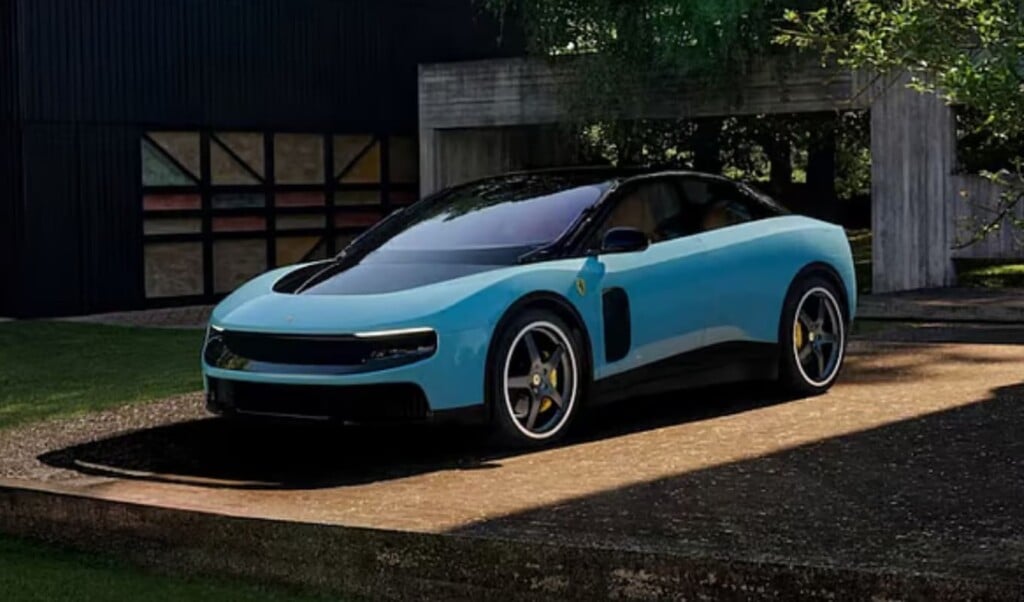
The legendary Italian manufacturer Ferrari has entered a completely new era with the launch of its first-ever fully electric vehicle (EV), named the Luce. Meaning “light” in Italian, the vehicle represents a major strategic shift for a luxury brand traditionally defined by its roaring petrol-powered internal combustion engines. However, the unconventional aesthetics of the model have triggered an unprecedented wave of public and institutional backlash.
High-Profile Launch Met with Financial and Public Backlash
The unveiling of the Luce was structured as a monumental event, drawing high-profile dignitaries including Italian President Sergio Mattarella and Pope Leo. Despite the intense anticipation surrounding the debut, the subsequent reception by social media critics, financial investors, and politicians has been highly critical.
On the morning following the launch, Ferrari’s share price plummeted by as much as 8 per cent on the Milan stock exchange before stabilizing at a 6 per cent decline. Concurrently, the internet became flooded with numerous satirical memes and jokes targeting the vehicle, which carries an estimated retail price of $640,000 (€550,000). The vehicle also marks a structural milestone as the first-ever five-seat, four-door liftback saloon in Ferrari’s history.
Minimalist Design versus Brand Heritage
The vehicle’s exterior and interior were styled by LoveFrom, an outside creative collective led by former legendary Apple product designer Sir Jony Ive and industrial designer Marc Newson. Unlike traditional Ferraris, the Luce lacks an aggressive silhouette, opting instead for smooth, continuous minimalist lines and a forward-set cabin.
This drastic departure from Maranello’s design language has divided experts and automotive figures alike:
-
Luca Cordero di Montezemolo (Former Ferrari Chairman): Stated that the Luce risks damaging the identity of the legendary company, going so far as to suggest that Ferrari’s iconic prancing horse logo should be removed from the model.
-
Matteo Salvini (Italy’s Deputy Prime Minister and Transport Minister): Questioned the nature of the innovation, wondering aloud what founder Enzo Ferrari would have thought and stating that the vehicle does not resemble the traditional image of the brand.
-
Shaun Baker (Luxury Car Dealer and Collector): Expressed that the vehicle damages the aspirational image of Ferrari, mockingly referring to the “Luce” as a “loser”.
-
Pierre-Olivier Essig (Head of Research at AIR Capital): Commented that the car looks like a cross between a Tesla Model 3 and a Honda Accord EV, noting that observers are left “lost in translation” regarding Ferrari’s new direction.
Conversely, a small minority of commentators have defended the car, praising it as a unique and daring example of automotive design.
Technical Performance and Market Context
While its design is heavily disputed, the engineering specifications of the Luce retain the performance benchmarks expected of a modern supercar. Powered by four independent radial-flow permanent-synchronous electric motors, the vehicle produces a combined 1,035 horsepower ($1,050\text{ cv}$). It features an 880V structural battery pack with a 122-kWh capacity, delivering an official driving range of 530 kilometres (329 miles) under the WLTP testing cycle.
Performance and Technical Specifications
| Parameter | Specification Metric |
| Powertrain Configuration | Quad-motor, All-Wheel-Drive (AWD) |
| Total Power Output | 1,035 hp / $1,050\text{ cv}$ |
| Battery Capacity | 122 kWh (880-Volt Architecture) |
| Acceleration (0–96 km/h / 0–60 mph) | 2.5 seconds |
| Maximum Top Speed | Over 305 km/h (193 mph) |
| Official Driving Range (WLTP) | 530 km (329 miles) |
| Seating Capacity | 5 seats (First for Ferrari) |
| Base Price (Europe) | €550,000 (Approx. $640,000) |
Rather than using an artificial combustion engine track, the Luce features an acoustic pickup system on the rear axle that captures actual mechanical vibrations from the electric drivetrain and amplifies them into the cabin, a setup the company likens to an electric guitar amplifier.
The Broader Landscape of Luxury EV Transitions
Ferrari is not the only historic manufacturer to face pushback over an electric transition. In 2024, Jaguar announced its intention to reinvent itself as an ultra-luxury electric brand, showcasing the “Type 00” concept car. Critics condemned that model’s long bonnet and oversized wheels as a total departure from Jaguar’s heritage, prompting Chief Executive Rawdon Glover to state that being bold and disruptive was necessary to command attention.
Ferrari’s Chief Executive, Benedetto Vigna, has robustly defended the Luce’s high pricing and styling, dismissing comparisons to mass-market Chinese EVs and asserting that innovation requires the courage to challenge conventions. He also reported strong early interest from potential prospective buyers.
However, the Luce arrives at a time when other major Western brands are scaling back their EV operations due to softening consumer demand and a persistent preference for combustion engines. Competitor Lamborghini recently cancelled its pure electric vehicle project to focus entirely on hybrid drivetrains, a move its Chief Executive, Stephan Winkelmann, described as the correct path. Similarly, Porsche, Honda, and Ford have curtailed their respective electric vehicle programmes.
Furthermore, Western manufacturers face intense competition from the Chinese market, where the International Energy Agency reports that production costs are at least 30 per cent lower due to a massive integrated parts supply chain and state subsidies. This allows Chinese firms to produce high-tech, long-range EVs at lower prices, forcing Western firms like Tesla and Volkswagen to slash prices in China.
Chinese companies are now also entering the high-end supercar market; the fully electric BYD Yangwang U9, priced at approximately $250,000, can accelerate from 0 to 96 km/h in 2.3 seconds.
Industry analysts suggest that with the Luce, Ferrari may consciously be targeting a younger, tech-focused demographic rather than traditional petrolheads. Sustainable industry specialist Jessica Cheam and automotive analyst James Wong noted that while the car may alienate traditionalists, its unique appearance and modern tech suite could successfully attract an entirely new class of wealthy consumers who previously never considered purchasing a Ferrari.