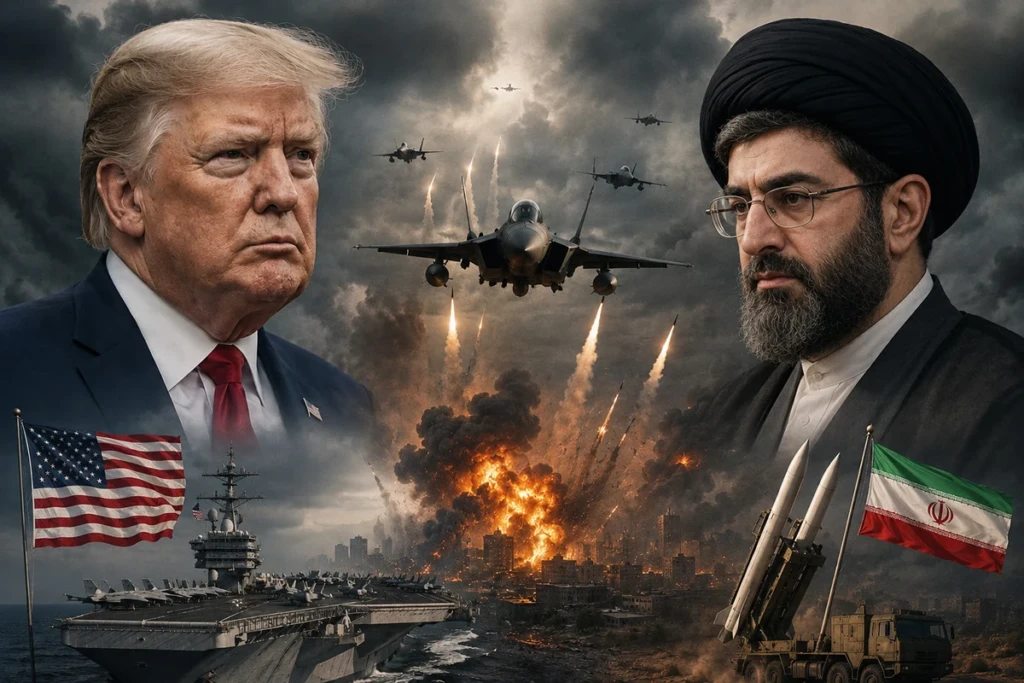
The United States and Iran have reached an agreement aimed at ending a war that lasted for more than three months across the Middle East. If the accord negotiated between US President Donald Trump and Iran is implemented without last-minute obstacles, it will bring an end to a conflict that some analysts have described as the most significant foreign-policy miscalculation of Trump’s presidency.
According to an analysis by BBC International Editor Jeremy Bowen, the conflict has raised fundamental questions about the limits of American power and its ability to deter adversaries. Beyond the battlefield, the war has also affected perceptions of Washington’s global influence and the confidence of its allies.
Bowen argues that the confrontation exposed constraints in US military and political leverage. He suggests that America’s deterrence capability has been weakened and that relations with the oil-rich Arab monarchies of the Gulf have come under increasing strain. Long regarded as islands of stability in an often turbulent region, Gulf states are now reassessing their security strategies and diplomatic priorities. Officials in several countries are reportedly considering alternative partnerships and exploring ways to coexist more effectively with neighbouring Iran.
The conflict was also closely monitored by China. As the United States committed substantial military resources to the war, observers noted that Beijing was carefully assessing the practical limits of American military capacity.
War Ends, But Peace Remains Elusive
Although the memorandum brings hostilities to an end, it does not constitute a comprehensive peace treaty. Negotiators have indicated that the document consists of 14 clauses spread across two pages, but its full contents have not yet been released.
Among the reported provisions are measures to facilitate the reopening of the Strait of Hormuz, the removal of the US naval blockade around Iranian ports, and the extension of the ceasefire.
However, the most contentious issues have been deferred to future negotiations. These include the future of Iran’s nuclear programme and the concessions Tehran may be expected to make in exchange for sanctions relief.
Key Elements of the Agreement
| Issue | Current Status |
|---|---|
| End of active hostilities | Agreed |
| Ceasefire extension | Included |
| Strait of Hormuz reopening | Planned |
| US naval blockade around Iranian ports | To be lifted |
| Iran’s nuclear programme | Future negotiations |
| Sanctions relief arrangements | Future negotiations |
Global Economic Significance
President Trump has stated that the agreement will reopen the Strait of Hormuz, one of the world’s most strategically important waterways. Approximately 20 per cent of global oil and natural gas supplies pass through the strait.
The route is also critical for transporting petrochemical feedstocks, fertiliser components and materials essential to advanced manufacturing industries. Disruptions caused by the war affected shipping and raised concerns about supply chains and commodity markets.
The conflict resulted in thousands of deaths across the region and caused extensive destruction of homes and businesses. Analysts have warned that prolonged disruption to maritime transport through the Strait of Hormuz could affect fertiliser production and increase the risk of food insecurity in poorer nations, particularly in sub-Saharan Africa.
Miscalculations by Washington and Tel Aviv
The analysis contends that both the United States and Israel underestimated Iran’s resilience and capacity for resistance. Prior to the outbreak of war on 28 February, policymakers in Washington and Tel Aviv reportedly believed that a rapid military campaign could trigger major changes within Iran’s governing system.
Instead, the anticipated political transformation did not occur. Rather than collapsing, Iran’s leadership structure adapted and survived. Following the deaths of Supreme Leader Ayatollah Ali Khamenei and several close associates, the country’s governing apparatus was reportedly reorganised with notable speed.
The analysis states that a new leadership structure emerged under Mojtaba Khamenei, supported by influential commanders of the Islamic Revolutionary Guard Corps (IRGC). While maintaining the ideological outlook of their predecessors, the new leadership is viewed as potentially more willing to take risks.
Iran’s Military Strategy
During the conflict, Iran threatened to close the Strait of Hormuz and adopted a strategy that included the possibility of strikes against Arab neighbours, US military installations and Israel.
The analysis further argues that subsequent developments cast doubt on earlier claims by US defence officials that Iran’s military capabilities had been comprehensively destroyed, suggesting that some assessments may have been overstated.
Israel Left Outside Negotiations
Despite being one of Washington’s closest partners during the war, Israel was not directly involved in the negotiations that produced the agreement. This has reportedly generated dissatisfaction within Israeli political circles.
Prime Minister Benjamin Netanyahu has long regarded Iran as Israel’s principal strategic threat. He previously stated that he had spent much of his political career awaiting an opportunity to dismantle Iran’s ruling system.
However, the outcome of the conflict has led to domestic criticism. Opponents argue that his policies have increased security risks for Israel rather than reducing them.
Lebanon and Regional Challenges
Another significant issue for Israel is its military presence in southern Lebanon. Israeli forces have displaced large numbers of civilians from the area and destroyed thousands of structures.
Israel’s defence minister previously indicated that military positions in parts of Lebanon, Syria and Gaza could remain in place for an extended period. At the same time, Netanyahu faces pressure from hard-line members of his coalition while also needing to manage relations with the United States.
A New Regional Order?
The BBC analysis concludes that the US-Iran agreement could create conditions for substantial changes in the Middle East. Nevertheless, deep mutual distrust and longstanding ideological differences continue to cast doubt over the prospects for a durable settlement.
The conflict is increasingly being viewed as a setback for all parties involved. Iran remains under a strict governing system, while the United States retains considerable economic and military power. Yet the decision to wage the war has prompted renewed debate about American influence in a changing international order and whether traditional assumptions about power in the Middle East remain valid.