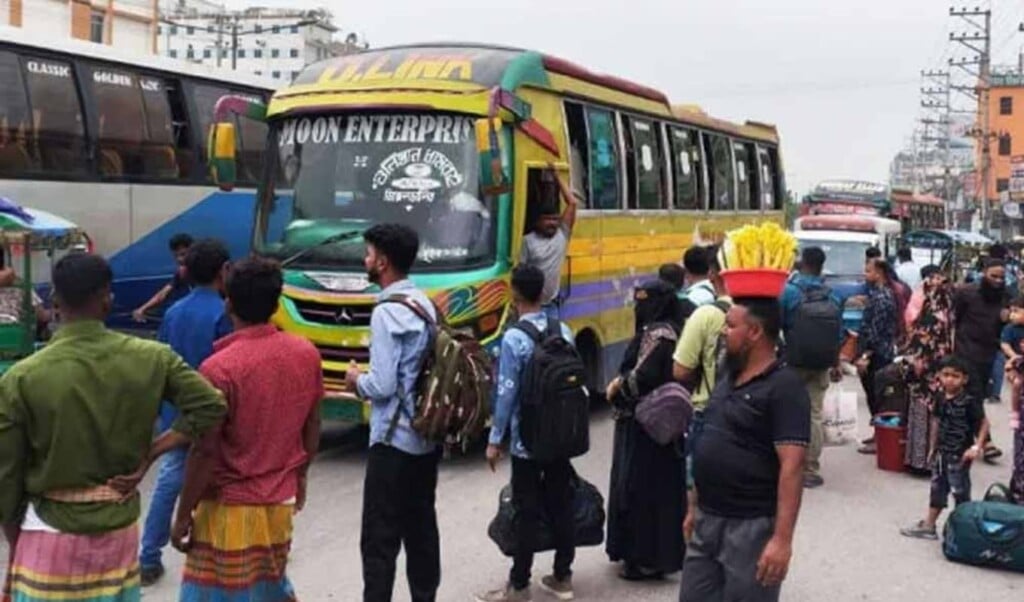
A steady stream of outbound commuters continued to exit the capital city of Dhaka on Friday, 29 May 2026, marking the second day of the nationwide Eid-ul-Adha holiday. Field assessments conducted during the morning hours revealed significant passenger activity concentrated across the city’s primary inter-district transport hubs, commercial booking counters, and suburban transit corridors.
This post-festival travel pattern is driven by specific demographic segments. The initial wave consists of industrial workers, corporate employees, and service-sector personnel who were legally or operationally required to remain on duty in the capital through the eve of the holiday. The secondary wave comprises urban families who completed their primary festive rituals within Dhaka on the first day and are now traveling to regional districts to celebrate the remainder of the holiday with extended families.
Terminal Efficiency and Arterial Highway Performance
In sharp contrast to the prolonged delays and structural gridlock that impacted the national transport network during the pre-Eid peak on Wednesday, Friday morning saw smooth operations across all routes. Commuters at major booking stations reported brief processing times and highly organized boarding procedures.
This increased travel efficiency is directly linked to a sharp drop in vehicular density across the national highway network. With heavy commercial freight, corporate logistics fleets, and industrial transport legally restricted for the holiday, the main arteries linking Dhaka to the northern, western, and southern districts remained completely clear. Commuters expressed satisfaction with the smooth traffic flow, noting that travel times had decreased significantly compared to the pre-festival averages.
The passenger distribution, operational status, and traffic velocity profiles recorded across Dhaka’s primary transport points are outlined in the table below:
| Terminal Classification | Field Observations & Asset Deployment | Velocity & Flow Status | Primary Passenger Demographic |
| Inter-District Hubs | Gabtoli, Sayedabad, and Mohakhali central terminals | Moderate-to-high footfall; consistent departures | Service-sector workers, late holidaymakers |
| Suburban Intersections | Technical Crossing, Uttara House Building, Signboard | Active roadside boarding; high fleet frequencies | Short-haul commuters moving to adjacent districts |
| National Highways | Dhaka–Tangail, Dhaka–Chittagong, Dhaka–Mawa | High-speed, free-flowing; zero traffic blocks | Long-haul operators and regional transit lines |
Fleet Management and Roadside Boarding Patterns
To manage the continuous arrival of late-stage travelers, long-haul transport corporations deployed additional vehicles from their reserve fleets to maintain high departure frequencies. Due to crowded conditions at central booking offices, many passengers chose to bypass the main terminals entirely. Instead, they gathered at major suburban intersections along Dhaka’s exit corridors to board passing coaches. These informal assembly points were highly active at Technical Crossing, Shyamoli, Kalyanpur, Uttara House Building, and the Signboard junction on the Dhaka–Chittagong highway.
Highway Patrol units and metropolitan police detachments remained deployed at these key locations to manage traffic flow and enforce transport safety compliance. Terminal supervisors confirmed that ticket pricing structures remained within the government-mandated holiday limits, preventing the arbitrary fare increases common during peak travel windows. Transport authorities expect outbound passenger volumes to level off by Saturday morning, at which point the regional transit network will transition to handle the initial wave of returning commuters.