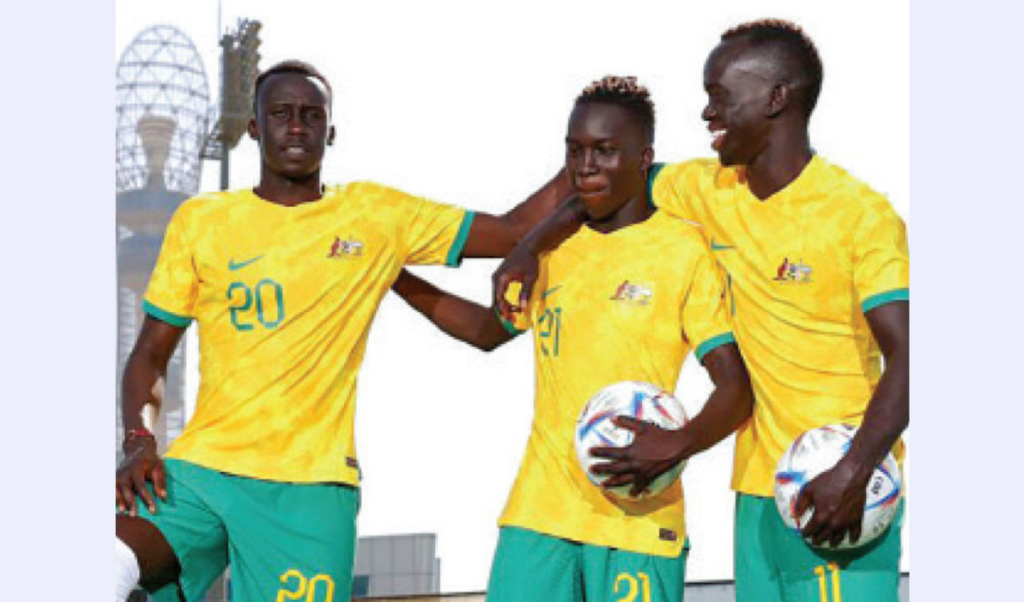
Following a notable 2-0 victory against Turkey, the personal backgrounds of two young Australian footballers who transitioned from refugee camps to the global stage have garnered significant attention. Exactly twenty years after Australian football’s celebrated ‘Golden Generation’ established their names across households, two African refugees have emerged as the primary faces of the Socceroos’ campaign at the 2026 FIFA World Cup.
Twenty-year-old Nestory Irankunda and twenty-two-year-old Mohamed Touré are currently regarded as two of the most exciting rising talents in Australian football. The opening goal in the historic 2-0 win over Turkey was scored directly by Nestory Irankunda.
The two young players share a multitude of career and personal parallels. Both individuals originally arrived in Australia as refugees from the African continent, with Irankunda migrating from Tanzania and Touré from Guinea. Furthermore, both athletes progressed through the youth academy of Adelaide United and are currently playing their club football in the English Football League (EFL) Championship in England.
Their breakthrough on the international stage occurs during a period of intensifying anti-immigrant rhetoric and politics globally. The 26-man Australia squad selected for the 2026 World Cup comprises players from at least 15 different cultural and ethnic backgrounds. The composition of this team serves as a contemporary reflection of 21st-century Australia, a nation where one in every three individuals was born overseas.
Career Trajectories and Club Breakthroughs
Known for his immense physical strength and exceptional pace, Mohamed Touré is currently serving as Australia’s primary lead forward. Operating as a striker for the English Championship club Norwich City, Touré experienced a significant breakout period during the 2025-26 season, scoring 9 goals in just 11 appearances.
Touré was born within a refugee camp located in Conakry, the capital city of Guinea. His parents had previously spent 14 years residing in the camp after fleeing the civil war in Liberia. When Touré was just seven months old, his family relocated to Australia under refugee status.
Both Touré and Irankunda, alongside their international teammate Awer Mabil, are official members of the United Nations High Commissioner for Refugees (UNHCR) ‘Gamechanging Team’. This initiative constitutes a symbolic global XI consisting entirely of footballers from displaced or refugee backgrounds. Mabil was also born in a refugee camp in Kenya to parents who had fled South Sudan, and he subsequently played for Adelaide United during the earlier stages of his career.
For Touré, representing the Socceroos and wearing the green-and-gold jersey represents a profound sense of personal freedom.
“Australia is a country that gave us opportunities and extended a helping hand,” Touré stated. “As a refugee, I never imagined that my career trajectory would lead me to a World Cup or that I would be playing for Norwich City.”
Cultural Representation and Sporting Idols
For Irankunda, the reality of black youth becoming the primary poster boys of football in a nation like Australia remains an extraordinary milestone. Speaking to the Australian Associated Press, he remarked:
“It feels crazy when you think about it, because who would have ever thought this? Now that it is actually happening, everyone is surprised and saying, ‘Wow’. I never thought this would be possible myself; maybe one day it would happen, but I did not expect it to occur this quickly.”
Reflecting on his childhood inspirations, Irankunda identified former international Tim Cahill as his primary sporting idol.
“During my upbringing, the person I looked up to for inspiration—I do not know if people consider him black—but I would say Tim Cahill,” Irankunda explained. “He was of Samoan background, so naturally, I idolised him, particularly his style of play. I have never met him to this day, but meeting him and having a long conversation is one of the biggest dreams of my life. What an extraordinary player he was, simply a top player.”
Irankunda was born in a refugee camp in Tanzania to parents who hold Burundian citizenship. The family subsequently migrated to Australia and settled permanently during his infancy.
The current Australian World Cup squad features a total of six Socceroos of African heritage. In addition to Touré (Guinea and Liberia) and Irankunda (Tanzania and Burundi), the selection includes Lucas Harrington (Zimbabwe), Jason Geria (Uganda), alongside Awer Mabil and Tete Yengi (both representing South Sudanese heritage).
Irankunda expressed immense pride regarding this collective representation, stating: “The fact that all of us from African backgrounds are playing here together in the national team is incredible to think about. It represents a massive source of pride for our entire African community.”