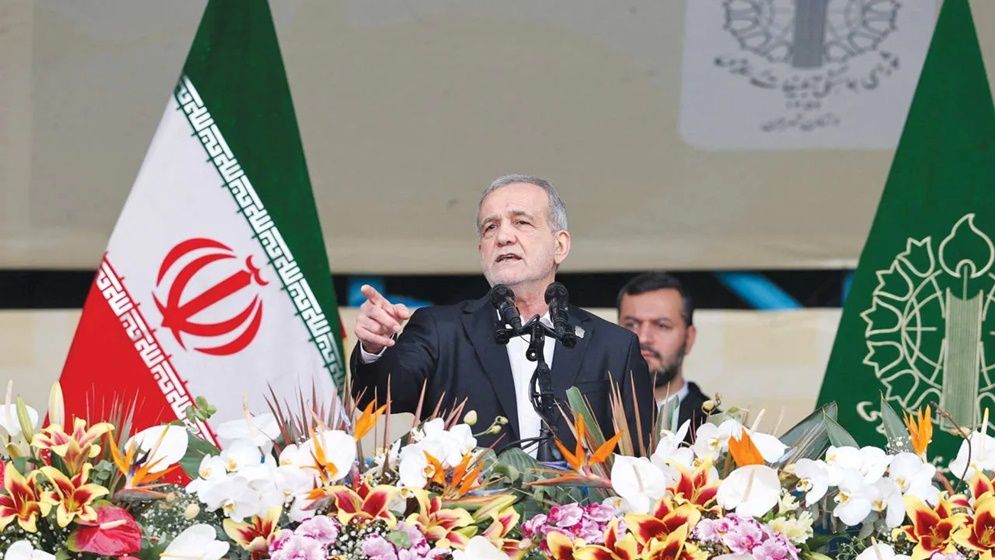
Tehran has firmly refuted mounting rumours regarding the resignation of Iranian President Masoud Pezeshkian, categorising the reports as a calculated “media game”. Government officials have stated that the Islamic Republic will not deviate from its path of national unity and solidarity, despite external assertions of an internal political rift.
The Origin of the Resignation Claims
The controversy intensified following a report by the broadcaster Iran International, which claimed that President Pezeshkian had submitted an official resignation letter to the office of the Supreme Leader on Sunday, 31 May. Citing unnamed sources, the outlet asserted that Pezeshkian explicitly requested immediate permission to step down from his position in a formal letter addressed to the Supreme Leader, Mojtaba Khamenei.
For several months, numerous officials within the United States administration have alleged that deep divisions exist between the Iranian civilian government and the nation’s military-security apparatus. Various Western media organisations have regularly circulated reports aligned with these claims, highlighting potential structural vulnerabilities within the state.
Allegations of Institutional Gridlock
Prior to this latest development, Iran International reported that the Islamic Revolutionary Guard Corps (IRGC) had systematically curtailed the executive powers of the president. The broadcaster alleged that the military branch had effectively seized control of critical governmental sectors, thereby precipitating a severe political and administrative stalemate within the Pezeshkian administration.
According to the reported contents of the alleged resignation letter, Pezeshkian argued that:
-
The presidency and the cabinet have been effectively excluded from core national decision-making processes.
-
Hardline factions within the IRGC have exploited the resulting governance vacuum to assume direct control over state administration.
-
Under such constrained circumstances, it has become impossible for the president to manage government operations and fulfil his constitutional obligations.
Political analysts note that if these claims regarding the resignation letter were verified, it would signal an unprecedented and profound division at the highest echelons of Iranian state power.
Tehran’s Official Rejection of the Claims
In response to the widespread dissemination of these reports, Mehdi Tabatabaei, the Deputy Head of Communications for the President’s Office, issued a strong denial on the social media platform X (formerly Twitter). Tabatabaei dismissed the claims as a continuation of foreign psychological warfare and a malicious “media game”.
Furthermore, he rejected all domestic and international speculation concerning internal political fractures, asserting that those attempting to undermine Iran’s national cohesion would take their unfulfilled ambitions to the grave. He concluded by reaffirming that President Pezeshkian remains fully committed to his mandate and will never abandon his service to the Iranian public.
Key Structural Dynamics of the Incident
The table below outlines the conflicting narratives and stances held by the involved entities:
| Entity / Source | Core Allegations and Assertions | Official Stance / Response |
| President Masoud Pezeshkian | Reportedly claimed exclusion from state decisions due to IRGC interference and requested permission to resign. | Remains in office; state officials confirm his unwavering commitment to serving the public. |
| Iran International & Western Media | Reported the submission of a formal resignation letter to Mojtaba Khamenei on 31 May, citing a severe power struggle. | Characterised by Tehran as a coordinated, fabricated “media game” aimed at destabilising national unity. |
| The President’s Office (Mehdi Tabatabaei) | Denied all rumours of administrative gridlock or internal fractionalisation within the executive branch. | Reaffirmed that national solidarity remains intact and strongly condemned foreign interference. |
| Islamic Revolutionary Guard Corps (IRGC) | Accused by external reports of usurping presidential authority and controlling key sectors through hardline factions. | Internal institutional conflict or structural deadlock explicitly denied by government representatives. |