The foundational essence of Bengali identity, rebellion, and egalitarianism is profoundly embodied in the nation’s Rebel Poet, Kazi Nazrul Islam. Upon the occasion of his 127th birth anniversary, a rigorous examination of historical records highlights a deeply significant and historically pivotal chapter in the poet’s life. This particular period remains inextricably linked to a visionary, state-level initiative orchestrated by the architect of independent Bangladesh, the Father of the Nation, Bangabandhu Sheikh Mujibur Rahman.
The Geopolitical Context of 1972
In the year 1972, the newly sovereign nation of Bangladesh was actively navigating the complex aftermath of a devastating war of independence. As the head of government, Bangabandhu Sheikh Mujibur Rahman was entirely immersed in the gargantuan task of national reconstruction and administrative stabilisation. Despite the overwhelming responsibilities of statecraft, the preservation and institutionalisation of Bengali cultural heritage remained a paramount priority for his administration.
Bangabandhu Sheikh Mujibur Rahman maintained a firm conviction that the poet whose literary works and iconic slogan, “Joy Bangla”, served as the foundational psychological inspiration for the freedom fighters during the Liberation War, deserved to be permanently and honourably repatriated to the soil of independent Bangladesh.
The Diplomatic Mission to Calcutta
To commemorate the 73rd birth anniversary of Kazi Nazrul Islam, Bangabandhu initiated an official state-level diplomatic mission to bring the ailing poet from Calcutta (now Kolkata) to Dhaka. For this historic assignment, Bangabandhu appointed two highly trusted personal emissaries:
-
Matiur Rahman: The then Minister for Public Works.
-
Mustafa Sarwar: The Cultural and Social Welfare Secretary of the Bangladesh Awami League.
These state representatives were dispatched to India bearing an official, profoundly respectful invitation letter penned directly by the Bangladeshi Head of Government. The archival text of the official correspondence from Bangabandhu Sheikh Mujibur Rahman states precisely:
“I am sending my friend and colleague Matiur Rahman and the Cultural Secretary of the Awami League, Mr Mustafa Sarwar, to you. Please accept my heartfelt greetings. On behalf of myself and the people of free, independent, and sovereign Bangladesh, I extend a formal invitation to you. On your birth anniversary, allow Bangladesh to be enriched by your ideals. We are eagerly awaiting your arrival in Bangladesh. I sincerely hope you will grace us with your presence. Joy Bangla.”
State Honours and Repatriation to Dhaka
Responding to this official state invitation, Kazi Nazrul Islam was ceremoniously and safely transported from Calcutta to Dhaka on 24 May 1972. Upon his historic arrival in the capital, the government formally declared Kazi Nazrul Islam as the “National Poet of Bangladesh,” a status that was subsequently institutionalised and legalised via an official government Gazette notification.
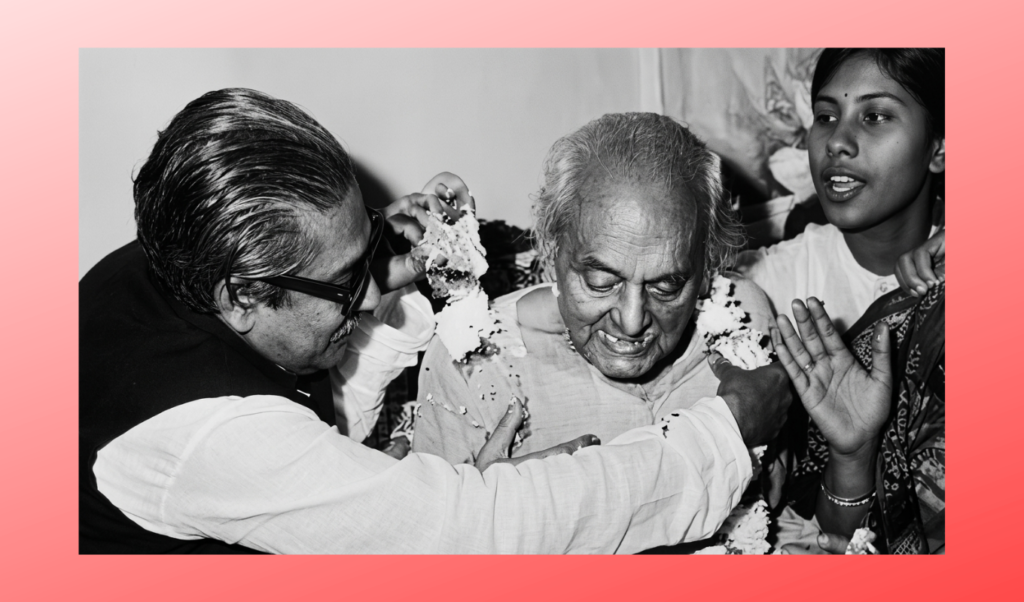
Following the poet’s arrival, Bangabandhu Sheikh Mujibur Rahman personally visited Kazi Nazrul Islam to render his utmost respects and official greetings. As a concrete demonstration of state reverence and welfare, the contemporary government allocated a fully furnished residence in the Dhanmondi residential area for the poet and his family. Concurrently, the state assumed full financial and logistical responsibility for his advanced medical treatment, long-term healthcare requirements, and the maintenance of a highly dignified standard of living.
| Milestone Event | Date / Location | Historical Significance |
| State Repatriation | 24 May 1972 | Moved from Calcutta to Dhaka following an official diplomatic invitation. |
| National Poet Declaration | Post-Arrival (1972) | Formalized via official government Gazette notification. |
| Demise | 29 August 1976 | Passed away in Dhaka at the age of 77 under state care. |
| Final Resting Place | Present Day | Laid to rest with full state honours adjacent to the Dhaka University Central Mosque. |
The decisive state action to bring Kazi Nazrul Islam to Dhaka went far beyond the scope of basic humanitarian relocation or welfare assignment. It effectively served as a foundational cornerstone for the secular, non-communal, and progressive cultural identity of the newly liberated Republic of Bangladesh.
The revered National Poet remained under the comprehensive care of the state and surrounded by the citizens of Bangladesh until his demise on 29 August 1976. In strict accordance with his underlying wishes, he was laid to rest with full state honours adjacent to the Dhaka University Central Mosque, where his final resting place remains a major national landmark.