A specialized wholesale market dedicated entirely to small freshwater fish operates on a precise daily schedule along the edges of the Kawadighi Haor. Located near Khaishaura village within the Moulvibazar Sadar Upazila, this seasonal marketplace opens between 4:00 pm and 5:00 pm and concludes promptly at dusk once local fishermen clear their daily catch.
Geographic Intersection and Commercial Dynamics
The trading hub forms around a concrete culvert structure in Karamullahpur village, marking the exact boundary where the Akhailkura and Ekatuna Unions meet. The immediate vicinity encompasses three tightly clustered villages—Karamullahpur, Kalaipura, and Khaishaura—with local traders using the names interchangeably to reference the market site.
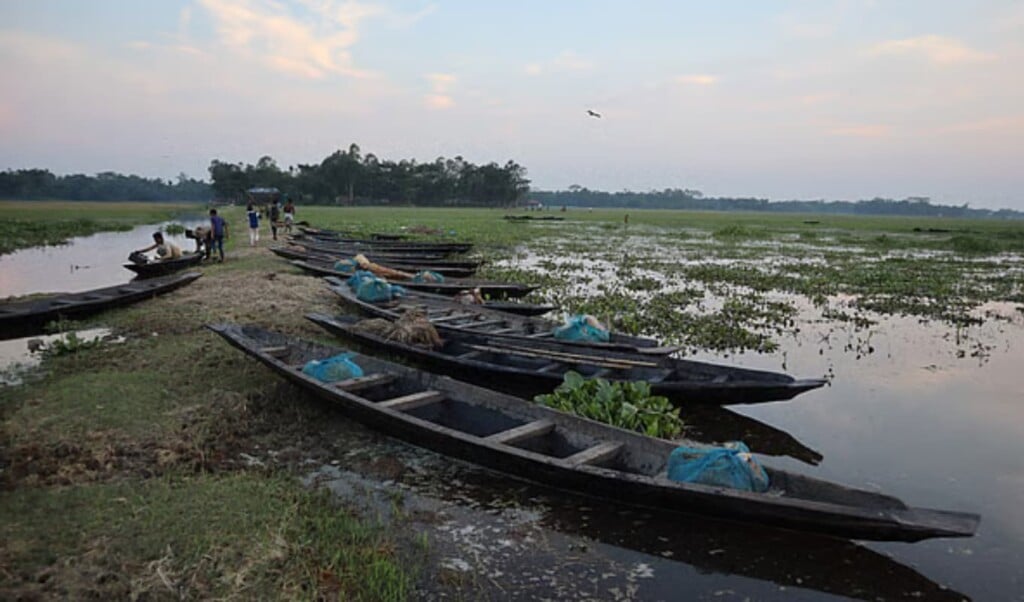
During the peak heat of the afternoon, the bridge serves as a gathering point where villagers assemble to catch the steady breeze blowing off the Kawadighi Haor. The crowd consists of fishermen landing their vessels, wholesale agents, and local onlookers. As fishermen arrive from the water, they transport their catch up to the road using traditional woven baskets called chaungra or shoulder-slung containers. Wholesalers instantly cluster around the incoming hauls to negotiate prices, shifting the purchases into plastic transport crates and specialized wicker baskets.
Local representatives Renu Miah and Durud Miah confirmed that the market serves almost exclusively as an immediate wholesale clearing zone for the surrounding villages. Once the day’s transactions wrap up at nightfall, retail distributors instantly load the inventory onto vehicles, transporting the fish to the urban centers of Moulvibazar town, specifically TC Market and West Bazar, for retail sale the following morning.
Catalog of Native Freshwater Fish Harvests
The daily transactions at the Karamullahpur bridge consist exclusively of wild, small-stature indigenous fish species extracted from the freshwater ecosystem of the haor. The standard daily catch features:
| Local Fish Variety | Scientific Classification / Common Name |
| Mokha (Mola) | Amblypharyngodon mola (Mola Carplet) |
| Puti | Puntius sophore (Pool Barb) |
| Tangra | Mystus vittatus (Striped Dwarf Catfish) |
| Koi | Anabas testudineus (Climbing Perch) |
| Meni | Nandus nandus (Gangetic Leafed Fish) |
| Khoia | Native Striped Barb variety |
| Chang | Channa orientalis (Asiatic Snakehead) |
| Chanda | Chanda nama (Elongate Glassy Perchlet) |
Fishing Schedules and Seasonal Patterns
The economy of Karamullahpur, Kalaipura, and Khaishaura is deeply intertwined with the haor’s seasonal water cycles. Local data indicates that between 150 and 200 small wooden boats travel into the Kawadighi Haor every day during the high-water months. These boats carry either one or two fishermen who deploy fine-mesh drift nets known locally as pata jal.
To maintain their yields, the fishermen divide their operations into distinct working blocks:
-
The Midday Shift: Fishermen set out onto the haor at approximately 2:00 pm, tending their nets for four hours before returning to the culvert by 6:00 pm to sell their fresh catch.
-
The Late-Night Shift: Crews launch their boats at 3:00 am to pull up stationary nets left in the haor overnight, retrieving the trapped fish before dawn.
-
Continuous Double-Shifts: A significant portion of the local workforce works both shifts, ensuring they have fresh fish available for the critical late-afternoon wholesale trading window.
Mosharraf Miah, a resident fisherman from Khaishaura, stated that his routine involves entering the water at 2:00 pm and returning by 6:00 pm. His typical afternoon catch yields an average market value between 500 and 600 Taka. Similarly, another local fisherman, Tanzil Hasan, noted that his afternoon haul generally commands a price of 500 to 700 Taka. Hasan explained that after sorting his fish into plastic crates at the landing ghat, he tethers his boat alongside the water hyacinths to rest before returning to the haor at 3:00 am for his next harvest. This rigorous cycle continues daily for as long as the high seasonal waters sustain the haor’s fish populations.