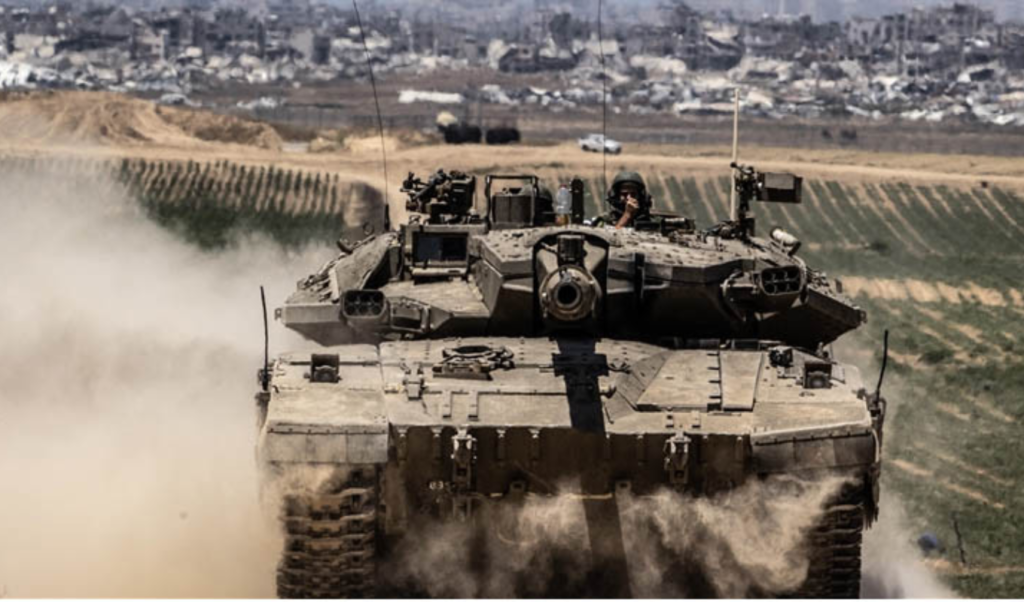
The Lebanese armed group Hezbollah has executed a targeted missile strike against an Israeli military tank stationed at the Beaufort Castle historic site in southern Lebanon. According to an official statement issued by Hezbollah, the targeted vehicle—a Merkava main battle tank—was completely destroyed during the operation. The high-profile strike marks an ongoing escalation in the border region following recent territorial advancements by the Israel Defense Forces (DF).
Territorial Dispute Surrounding Beaufort Castle
The geopolitical tension surrounding the location intensified on 31 May 2026, when Israeli forces advanced and secured operational control over Beaufort Castle, situated near the southern Lebanese city of Nabatieh. The capture of the historic fortress was widely publicised by Israel as a symbolic and tactical victory against Hezbollah’s regional infrastructure. However, the installation has since become a focal point for persistent counter-offensives mounted by Lebanese fighters.
Since the initial occupation of the fortress by the IDF, Hezbollah units have launched a sequence of consecutive ambushes, resulting in multiple Israeli military fatalities and numerous injuries. To circumvent Israeli electronic countermeasures and early-warning radar systems, the armed group has prominently deployed specialised fibre-optic guided drones during these incursions.
Because these uncrewed aerial vehicles utilize physical fibre-optic tethers for data transmission rather than traditional radio frequencies, they are entirely immune to conventional electronic jamming and are exceptionally difficult for air defence networks to detect prior to impact.
“The enemy must immediately cease its aggression against the Lebanese population, completely evacuate all occupied territories, withdraw behind recognized international borders, and explicitly respect the territorial integrity of Lebanon,” stated the Islamic Revolutionary Guard Corps.
Logistical Strikes and Broader Regional Assertions
In tandem with the anti-tank missile strike at Beaufort Castle, Hezbollah forces executed a coordinated bombardment against a newly established Israeli logistical support hub located at Qal’at al-Shaqif, the wider archaeological ridge where the fortress stands. The assault targeted the supply chains and engineering units reinforcing the forward operating base.
The military escalation has been closely mirrored by diplomatic and strategic declarations from regional allies. On Thursday, 4 June 2026, Iran’s Islamic Revolutionary Guard Corps (IRGC) issued a formal communique through the state’s semi-official Tasnim News Agency. The IRGC cautioned that sustainable peace within the Middle Eastern theater remains entirely impossible unless Israel executes a total withdrawal of its military assets from Lebanese sovereign soil.
Key Preconditions for Regional Stability Outline by IRGC
-
Comprehensive Ceasefire Execution: The primary condition for accepting any regional armistice requires a simultaneous and comprehensive ceasefire across all active combat fronts, explicitly including Lebanon.
-
Immediate Withdrawal: Israeli forces must urgently cease offensive operations against Lebanese civilians and retreat behind internationally established borders.
-
Sovereign Recognition: The state of Israel must formally recognize and respect the complete territorial integrity and airspace of Lebanon.
Hezbollah Leadership Rejects Disarmament Demands
Concurrently, the Secretary-General of Hezbollah, Naim Qassem, released an independent statement addresses to international mediators and domestic political entities. In his address, Qassem strongly criticised the ongoing diplomatic coordination and direct negotiations taking place between the Lebanese central government and Israeli authorities.
The political leader firmly rejected any proposed framework that conditions a permanent ceasefire on the total disarmament or surrender of the “Resistance Forces” weaponry. Secretary-General Qassem reiterated that a viable resolution to the conflict necessitates a complete, unconditional ceasefire across the entirety of Lebanon, alongside the absolute evacuation of all foreign troops from the nation’s geographical boundaries.