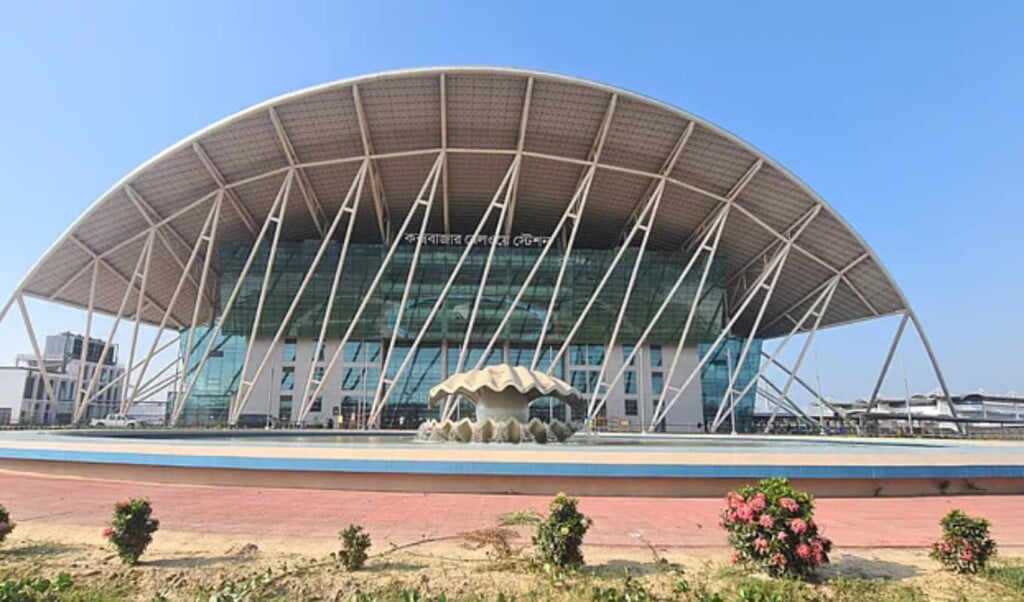
The iconic oyster-shaped railway station in Cox’s Bazar, located six kilometres from the town’s beach area in Chander Para, remains severely underutilised. Inaugurated on 11 November 2023 following an investment of approximately 236 crore BDT (£21.5 million), the terminal has crossed two and a half years of existence. Although the physical infrastructure was fully constructed, the vast majority of commercial and passenger amenities have not yet been activated.
The six-storey, fully air-conditioned terminal building covers an area of 1.87 million square feet across a 29-acre site. It serves as the coastal terminus for the 102-kilometre Dohazari-Cox’s Bazar railway corridor. Despite high profitability, the line suffers from a restricted schedule, an absolute lack of freight operations, and unmonitored level crossings that have contributed to numerous fatalities.
Disconnect Between Architectural Design and Service Delivery
The large multi-level facility was structurally designed to provide integrated transport and commercial services to incoming tourists:
| Building Level | Designated Infrastructural Allocation | Real-Time Operational Status |
| Ground Floor | Information desk, mosque, children’s zone, lounge, footbridge, lockers | Passenger amenities and lockers remain locked or non-functional |
| Second Floor | Retail shopping mall, childcare unit, commercial restaurants | Closed entirely to the public; zero commercial trade |
| Third Floor | 39-room star-rated premium hotel | Non-operational and vacant |
| Fourth to Sixth Floors | Conference halls, restaurants, childcare hubs, administrative offices | Only internal railway management offices are currently occupied |
| External Forecourt | Architectural oyster fountain, dual vehicular parking bays | Main fountain is switched off; forward entry gates are barricaded |
When the project was inaugurated, railway authorities announced that tourists could travel to the beach and return to Dhaka on overnight trains without needing to rent local hotel rooms, relying instead on the station’s paid luggage locker rooms. Max Infrastructure Limited, the domestic contractor responsible for construction, verified that all structural works were finalized and the facility was formally handed over to Bangladesh Railway last March.
However, current operations reveal that the main front entrance remains locked. Passengers arriving on incoming trains are directed through a solitary, narrow exit on the eastern platform, creating severe bottlenecks as departing passengers try to enter the same way. All escalators, retail outlets, and baggage scanners are currently deactivated.
“We had no idea this aesthetic railway station would be in such a state. There is only a single functional toilet, leading to long queues of men, women, and children. Dragging heavy luggage while carrying children all the way to the parking lot is extremely frustrating.”
— Kamrul Hassan, a passenger from Dhaka.
Other commuters shared similar experiences. Nazmul Huda, a retail businessman from Dhaka, noted that the ground-floor prayer spaces and information desks are entirely closed. Fazlul Karim, a holidaymaker from Rajshahi, stated that because the locker systems are non-functional, arriving tourists are forced to travel immediately into the town center purely to store their personal belongings. Station ticket collectors, speaking anonymously, stated that checking tickets at a single shared gate causes persistent arguments with crowded passengers.
Deficient Level Crossings and Elevated Track Risks
The construction of the broader 18,034 crore BDT Dohazari-Cox’s Bazar railway line began in July 2018 as a government fast-track priority project. The engineering works were split into two separate tranches and executed by a joint consortium consisting of China Railway Engineering Corporation (CREC), China Civil Engineering Construction Corporation (CCECC), Toma Construction Company, and Max Infrastructure Limited.
Commercial rail services commenced on 1 December 2023. The line has scaled up operations from one pair of trains to four pairs running six days a week. Although the route processes roughly 4,000 passengers daily, the direct trains only stop in Chittagong, completely bypassing the nine sub-stations built along the 102-kilometre track, leaving local intermediate communities without access.
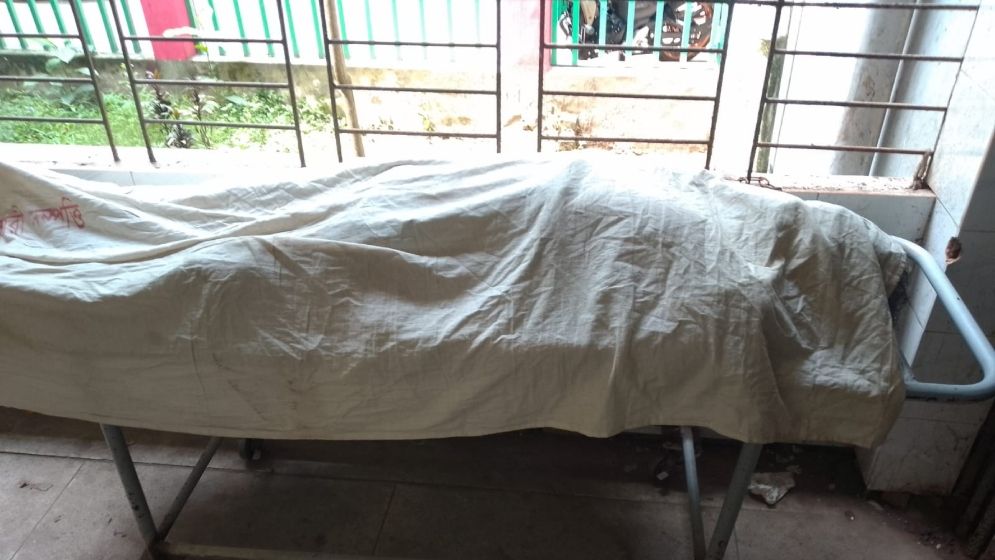
The rapid implementation of train timetables has created severe safety risks due to a lack of approved staff from the Ministry of Finance. Out of 72 authorized level crossings along the entire route, 56 lack physical barriers or permanent gatekeepers. Railway Police records confirm that 33 people have been killed along the tracks over the last 21 months after being struck at unmonitored crossings or run over while walking on the rails. In addition, a wild elephant was struck and killed by a train on the night of 13 October last year.
Temporary staff have been deployed unevenly across the different railway sections due to the lack of permanent manpower approvals:
-
Ramu-Cox’s Bazar Section: Only one out of eight level crossings has a gatekeeper.
-
Dulahazara-Islamabad Section (13 km): Only one out of twelve level crossings is monitored.
-
Chakaria-Dulahazara Section (11 km): Only three out of nine level crossings have gatekeepers.
Stagnant Freight Potential and Regional Impacts
The lack of dedicated cargo trains has drawn criticism from regional business organizations. Abdus Sukkur, President of the Cox’s Bazar Chamber of Commerce and Industries, stated that the ongoing delay prevents the efficient transport of locally produced salt, dried fish, marine fish, and shrimp to the rest of the country. It also blocks the domestic distribution of goods imported from Myanmar via the Teknaf land port.
Abul Kashem Sikdar, President of the Cox’s Bazar Hotel Guest House Cottage Owners’ Association, emphasized that 7 to 8 million tourists visit the seaside city annually. Their primary transit option remains the narrow, two-lane Chittagong-Cox’s Bazar highway, where a standard three-hour journey routinely takes six to seven hours due to traffic. Increasing the frequency of trains would provide a safer and more reliable alternative.
Mukiim Khan, General Secretary of the Cox’s Bazar Hotel Resort Owners’ Association, observed that the iconic terminal functions as nothing more than a hollow shell for holidaymakers. Leaving major commercial segments idle causes the infrastructure to degrade while depriving the government of vital non-fare revenues.
Administrative Responses
Addressing the operational delays, Station Manager Golam Rabbani stated that the entire building is scheduled to be handed over to a private commercial contractor in July, which will fully activate all passenger services.
Project Director and General Manager (East) of Bangladesh Railway, Md. Suboktagin, stated that basic operational activities, the waiting hall, and luggage scanners are currently functioning. He stated that the formal tendering process for commercial operations would be finalized by 30 June, allowing a private operator to assume full maintenance, commercial, and security duties in July.
Regarding track safety, Md. Suboktagin asserted that all level crossings are legally authorized and feature warning signs, adding that 46 pedestrian underpasses have been built to facilitate safe crossing. He acknowledged the manpower shortages but stated that efforts to place staff are ongoing. Regarding freight transport, he confirmed that discussions to introduce cargo trains remain underway. Ayasur Rahman, President of the Cox’s Bazar Bachao Andolan, urged the immediate installation of automated signaling, emergency gatekeeper recruitment, and public awareness campaigns to educate local residents on railway safety laws.