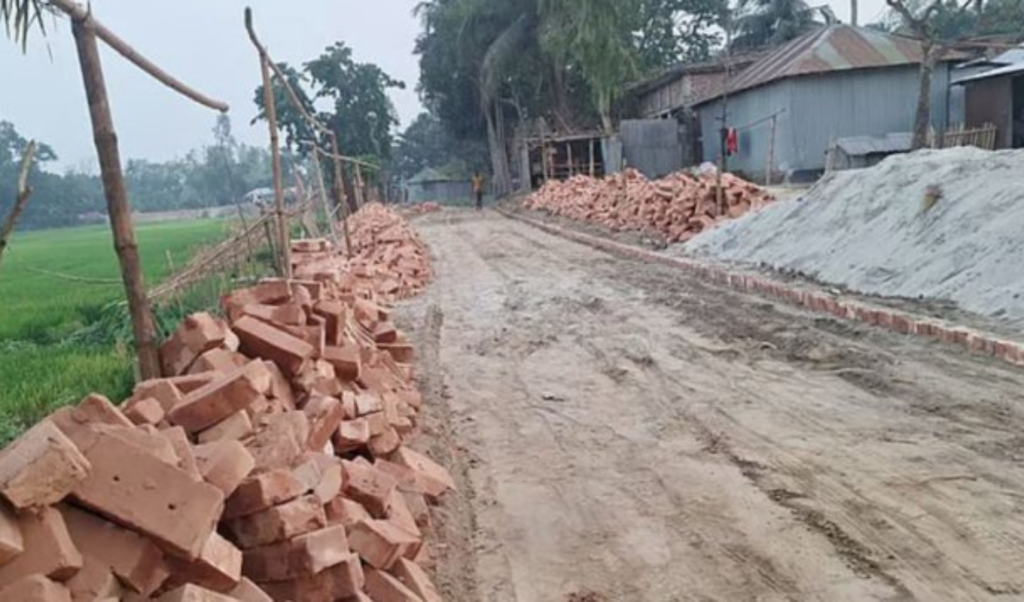
The Local Government Engineering Department (LGED) has removed bricks and sand from a half-kilometre unpaved road in the Gabtali Upazila of Bogra following a visit by Prime Minister Tarique Rahman. The rapid deployment and subsequent dismantling of the road infrastructure in the Bagbari area has triggered extensive discussions and criticism among local residents and administrative observers over the transparency of the public works execution.
The infrastructure work was initiated under a tight schedule ahead of the prime ministerial visit to facilitate vehicular and pedestrian movement. According to local sources, the bricks used to temporarily stabilise the unpaved surface were hired from a commercial kiln rather than permanently acquired, leading to widespread public questioning once the materials were lifted and transported back after the high-profile departure.
Allocation Details and Fixed Project Scope
According to official data provided by the Local Government Engineering Department (LGED), a permanent infrastructure development project covering the 500-metre road stretching from the Nashipur Union Parishad towards Ziabari via Choukir Khal had already been formally approved. A total financial allocation of 84 lakh BDT was cleared prior to the visit, and following the completion of the standard competitive bidding and tendering procedures, a construction contractor was awarded the work order to execute permanent bitumen carpeting.
On 20 April, Prime Minister Tarique Rahman arrived in Bogra to inaugurate a family card distribution programme at the Bagbari Shahid Zia Degree College field. Following the opening of the Choukirdeh canal excavation project, the prime minister scheduled a visit to his ancestral residence located in Ziabari. To ensure the unpaved connectivity link was immediately trafficable for the prime minister’s motorcade, authorities devised a temporary measure to rent bricks for a short-term brick-soiling layer at an estimated cost of 10 lakh BDT.
Official Explanations on Material Procurement
Administrative officials from the engineering department defended the action, clarifying that the deployment was never intended to be a permanent road installation but was instead an interim arrangement that did not interfere with the long-term master plan. Md. Masuduzzaman, the Executive Engineer of the Bogra LGED office, stated that because the major capital allocation for the permanent carpeting project had already been fixed, the temporary brick-soiling had to be removed to clear the alignment for the core engineering works. He emphasised that the bricks were rented on a contractual basis, which conserved public funds and left the site unencumbered for the main contractor.
Atiqur Rahman, the contractor responsible for laying the temporary surface, corroborated this operational framework. He confirmed that under specific directives from the LGED, the bricks were transported directly from a local kiln, laid on the unpaved segment, and fully dismantled and returned to the source after the prime minister concluded his visit. He argued that besides the primary expenditure for labour and logistics, no additional resource wastage occurred. Furthermore, Gabtali Upazila Engineer Md. Sazedur Rahman noted that while boundary disputes had caused initial delays, structural preparations and protective boundary construction are currently advancing to finish the permanent road within the stipulated timeline.
Institutional Governance and Financial Transparency Questions
Despite institutional reassurances that the project will eventually upgrade regional transit, transport agricultural goods efficiently, and improve access to schools and local markets, civil society groups have expressed strong reservations regarding the legal basis of using temporary hired materials for VIP visits. K Z M Faruk, the Secretary of the administrative watchdog “Sushashoner Jonno Proshashon” (Supro) Bogra chapter, challenged the financial propriety of the operation:
“Once the tendering process for paving an unpaved road is completed, there is no scope for spending any additional state funds there. Spending such state money solely centering on the visit of a state guest is a waste of state funds. Furthermore, laying bricks on an unpaved road in a hurry for the Prime Minister’s arrival and then lifting them after his departure constitutes severe trickery. No matter how much government money is shown to be spent on this work, questions will arise regarding its transparency.”
Local citizens remarked that the community has long anticipated a permanent road structure. While the commencement of the official 84 lakh BDT project offers hope for long-term self-sufficiency, the swift removal of the temporary bricks has left the path unpaved once again, intensifying local demands for a sustainable and permanent engineering solution over transient cosmetic upgrades.