US President Donald Trump has announced what he described as an agreement aimed at ending hostility between the United States and Iran, although significant uncertainty remains regarding its scope, implementation, and durability.
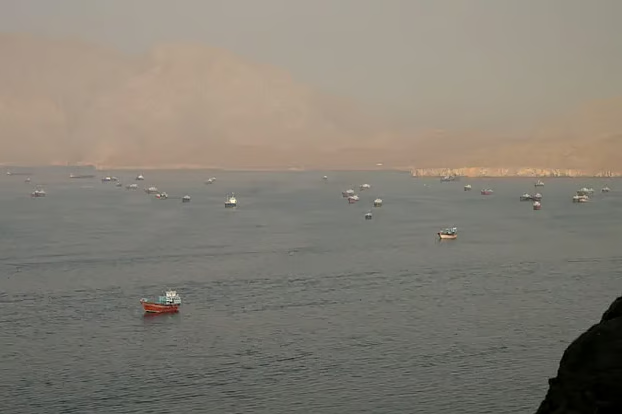
The announcement coincided with his birthday on 14 June, when he turned 81. In a post on social media, he stated that an understanding had been reached with Iran under which the Strait of Hormuz would remain open to commercial shipping and the United States would lift its naval blockade. On Sunday, he further wrote: “Let the oil flow.”
He also characterised the development as a “great deal” that would deliver “peace and security” across the region, contrasting it with what he described as the failures of previous US administrations. However, the language used was not unusual for the president, who has previously made similarly emphatic claims regarding other international conflicts.
In a previous example cited in the report, he had described a Gaza-related initiative as ushering in a “forever peace” and a “golden age of faith, hope and God”, although the situation on the ground did not reflect those outcomes.
According to US Vice President JD Vance, speaking to Fox News, the agreement includes a commitment that Iran will not obtain nuclear weapons, and that the United States would be able to verify compliance. However, several key issues remain unresolved, particularly concerning restrictions on Iran’s uranium enrichment programme and the status of its existing stockpiles of highly enriched uranium.
Further clarification is expected in subsequent rounds of negotiations. While some progress has reportedly been made during ongoing ceasefire-linked talks, the agreement remains incomplete, with critical details still under discussion.
Iran’s Supreme National Security Council issued a statement indicating that final negotiations would remain suspended unless the other party implements its commitments under the memorandum of understanding. The statement underscored that the continuation of talks depends on mutual compliance.
Energy market specialists have warned that an immediate return to pre-conflict oil transit levels through the Strait of Hormuz is unlikely. They noted that clearance of tanker congestion, mine removal operations, and the restoration of regular oil production and transport could take several weeks.
Although an official signing is still days away, both sides reportedly retain the opportunity to finalise outstanding issues. However, the possibility of breakdown remains, given unresolved technical and political questions.
Israel is also identified as a key external factor influencing the situation. According to the report, President Trump told The Wall Street Journal that he was angered by Israeli Prime Minister Benjamin Netanyahu over reported military actions in Lebanon, which he suggested could undermine the developing agreement.
There is also concern that renewed Israeli military operations could trigger retaliatory actions affecting the Strait of Hormuz, potentially disrupting global energy flows.
JD Vance acknowledged the wider economic consequences of elevated energy prices, noting their impact on US consumers. He also indicated that fuel prices are expected to decline in the near term.
The domestic political context in the United States remains relevant, with upcoming midterm elections scheduled for November. Public opinion polling referenced in the report indicates declining approval ratings for Trump’s economic management, with 63 per cent of respondents in a YouGov survey disapproving, and 57 per cent believing the economy is worsening.
Whether the agreement leads to sustained reductions in energy prices and broader economic relief remains uncertain, particularly given the unresolved diplomatic and security issues surrounding its implementation.
Key Elements of the Report
| Issue | Current Status |
|---|---|
| US–Iran agreement | Announced but not fully finalised |
| Strait of Hormuz | Claimed to be open, implementation unclear |
| US naval blockade | Reported intention to lift |
| Iran nuclear programme | Commitment to prevent weaponisation, verification unclear |
| Uranium stockpile | Status unresolved |
| Negotiation process | Ongoing, with suspended elements |
| Regional security factor | Israel and Lebanon developments |
| Energy markets | Disruption expected to ease gradually |
| US political context | Midterm elections approaching, economic approval declining |